


Stable Isotope Labelled Standards: Investing in High-Purity Material for Modern Scientific Research
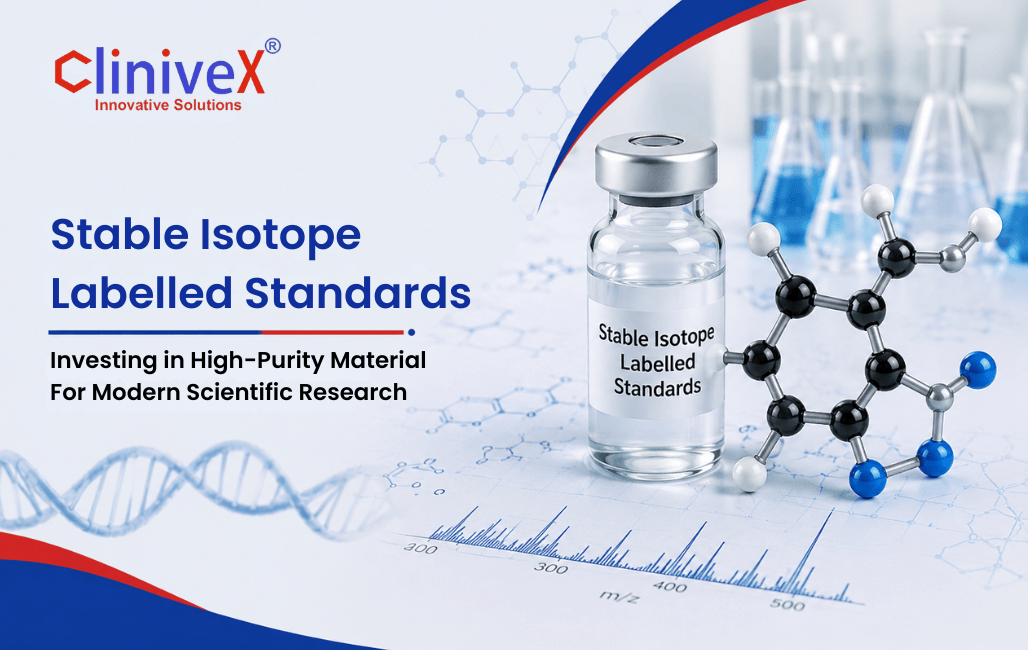

Science and technology are moving incredibly faster than ever before. Today, the researchers are discovering new biomarkers for diseases, developing advanced medicines, and testing environmental safety at a rapid pace. However, as our scientific questions become more advanced, the tools we use to answer them must also evolve to be more reliable and precise.
Among the many advanced tools available today, isotope labelled reference standards stand out as a big breakthrough. They are widely considered a cornerstone of modern scientific research, helping laboratories meet strict global quality standards. Without these highly precise tools, verifying complex data in pharmaceutical and biochemical studies would be really difficult.
In this blog, we will discuss the crucial role of stable isotope-labelled standards in pushing the boundaries of modern scientific research by covering their meaning and applications.
What are Stable Isotope Labelled Standards?
Stable isotope-labelled standards are molecules where specific, naturally occurring atoms (commonly carbon, nitrogen, hydrogen, or oxygen) are replaced with heavier, non-radioactive isotopes, such as Carbon-13, Nitrogen-15, Oxygen-18, etc. This modification increases the mass of the molecule without changing its fundamental chemical behavior. As a result, laboratory instruments can easily distinguish these tagged molecules from the actual compounds that you are testing.
In modern labs, these standards function as an identical twin to the compound you need to measure. And because they mirror the target analyte through every phase of the sample preparation and analysis, they automatically correct for any procedural losses or matrix interference. This provides researchers with a highly reliable benchmark for absolute quantification.
Applications of Stable Isotope-Labelled Standards
1. Pharmaceutical Development & Pharmacokinetics (PK/PD)
During drug discovery, researchers must track exactly how a new compound breaks down inside the body. These standards serve as flawless internal controls in bioanalytical testing. They help ensure that drug concentrations in blood or tissue plasma are measured with the absolute precision required for regulatory approval.
2. Clinical Diagnostics & Therapeutic Drug Monitoring (TDM)
In hospital laboratories, accurate patient data is a matter of direct safety. These standards are widely used to monitor narrow-target therapies, such as oncology drugs. They eliminate testing anomalies, allowing doctors to confidently adjust drug dosages based on highly reliable patient blood data.
3. Proteomics & Large-Molecule Biologics
Quantifying massive, complex proteins and monoclonal antibodies presents a major analytical challenge. Heavy isotope-labelled amino acids integrate very smoothly into advanced workflows like SILAC. This enables researchers to precisely map cellular changes, discover new disease biomarkers, and evaluate the stability of the next-generation biologic therapies.
4. Metabolomics & Pathway Tracing
Understanding biological systems requires tracking tiny metabolic shifts over time. By introducing the isotope-labelled nutrients like sugars or amino acids into a system, scientists can trace metabolic flux. It reveals exactly how metabolic pathways change in response to diseases or new medical treatments.
5. Food Safety, Environmental & Forensic Testing
Detecting trace contaminants like industrial pesticides or illicit toxins in complex and messy samples is very difficult. These standards act as the ultimate analytical safety net. They correct for chemical interference from soil, water, or fatty foods and prevent dangerous false negatives in public safety testing.
Why Choose Clinivex for SIL Standards?
Choosing the right partner for your reference materials is critical to securing data integrity. This is why Clinivex supplies precisely synthesized stable isotope-labelled standards engineered for the most demanding quantitative analytical workflows in pharmaceutical research, clinical bioanalysis, environmental testing, and metabolomics.
A few reasons why you should always choose Clinivex for SIL standards include:
- Broad Catalog: Providing deuterium, carbon-13, nitrogen-15, and oxygen-18 across drugs, metabolites, and environmental toxins.
- Rigorous Quality: Every standard includes a detailed Certificate of Analysis (CoA) which verifies isotopic and chemical purity.
- Regulatory Alignment: Fully supporting laboratory compliance with strict FDA, EMA, and ICH M10 bioanalytical validation guidelines.
- Enhanced Accuracy: Designed to effectively correct for sample loss, ionization changes, and complex sample interference.
Conclusion
Sourcing high-purity reference materials is the best way to ensure precision in modern scientific research. And when you source from Clinivex, you get an extensive selection of stable isotope-labelled standards covering endogenous metabolites, lipids, amino acids, small-molecule drugs, bile acids, steroids, and environmental contaminants, all produced with high isotopic purity and chemical integrity.
related blog
Analytical Reference Standards: The Key Benchmarks to Support Method Validation & Calibration
Whenever a laboratory routinely tests new samples, it must prove that its testing procedures are...
The Role of Reference Standards Suppliers in Meeting Reagent Purity Standards
Chemical reagents are the hidden backbone of scientific research, manufacturing, and quality testing. Whether it...
Stable Isotope Labelled Standards: Investing in High-Purity Material for Modern Scientific Research
Science and technology are moving incredibly faster than ever before. Today, the researchers are discovering...