


What are the Different Types of Reference Standards Used in the Pharmaceutical Industry


The pharmaceutical industry significantly relies on precision to ensure every medication is safe and effective. Reference standards play a vital role in pharmaceutical research, development, and quality control.
These substances are benchmarks in analytical testing to ensure that pharmaceutical products meet established safety, quality, and efficacy criteria. By comparing a new batch of medicine against a known reference, scientists can identify even the smallest deviations. This process is essential for maintaining consistency across different production runs and different manufacturing sites.
To manage this complex task, the industry uses several categories of standards. Thus, before sourcing them from a reference standards supplier in Canada, understanding these different types is the first step in mastering pharmaceutical quality control and regulatory compliance.
Why Reference Standards Matter?
Reference standards matter as they:
- Enable accurate analytical method validation,
- Ensure batch-to-batch product consistency,
- Assist in meeting global regulatory standards,
- And, prevent compliance issues and product recalls.
Different Types of Reference Standards Used in the Pharmaceutical Industry
1. Impurity Reference Standards
Drug production inevitably involves impurities, and it is also a regulatory requirement to identify and measure them. A high-quality reference standards supplier always has a large library of well-characterized impurity reference standards for stability testing, validation, and method development.
2. API (Active Pharmaceutical Ingredient) Standards
In pharmaceutical formulations, API reference standards help verify the identity and concentration of the active ingredient. These standards are frequently used worldwide for accurate assay and purity analysis.
3. Isotope-Labeled Standards
These standards are versions of drug molecules where specific atoms are replaced with heavier isotopes. They are ideal internal mass spectrometry standards for precisely measuring drug concentrations in complex biological samples because they are chemically identical but differ in mass.
4. Working Standards
Working reference standards (also known as secondary standards or in-house standards) are high-purity substances qualified against primary reference standards for daily, routine analytical testing in labs. They offer a cost-effective way of conducting quality control and daily assays without wasting costly primary stocks. Their potency is strictly tracked to ensure they remain a reliable benchmark for drug testing.
5. Custom Synthesized Reference Materials
These are tailor-made substances created when official standards do not exist. They are very important for identifying unique impurities or novel drug molecules during development. By using these tailor-made materials, manufacturers can accurately verify proprietary processes and confirm product safety throughout the pre-commercialization phase.
Conclusion
High-quality reference standards are very important for effective pharmaceutical analysis. As a leading supplier of reference standards, Clinivex offers over 50,000 products, serving as a one-stop solution for laboratories and research organizations worldwide.
related blog
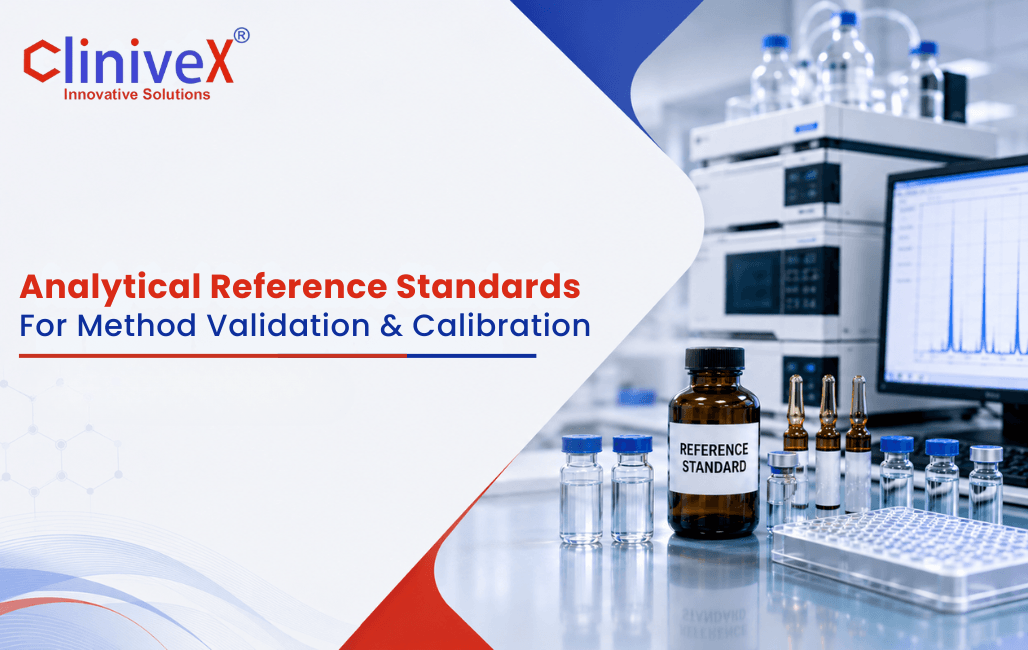
Analytical Reference Standards: The Key Benchmarks to Support Method Validation & Calibration
Whenever a laboratory routinely tests new samples, it must prove that its testing procedures are...

The Role of Reference Standards Suppliers in Meeting Reagent Purity Standards
Chemical reagents are the hidden backbone of scientific research, manufacturing, and quality testing. Whether it...

Stable Isotope Labelled Standards: Investing in High-Purity Material for Modern Scientific Research
Science and technology are moving incredibly faster than ever before. Today, the researchers are discovering...