


Analytical Reference Standards: The Key Benchmarks to Support Method Validation & Calibration
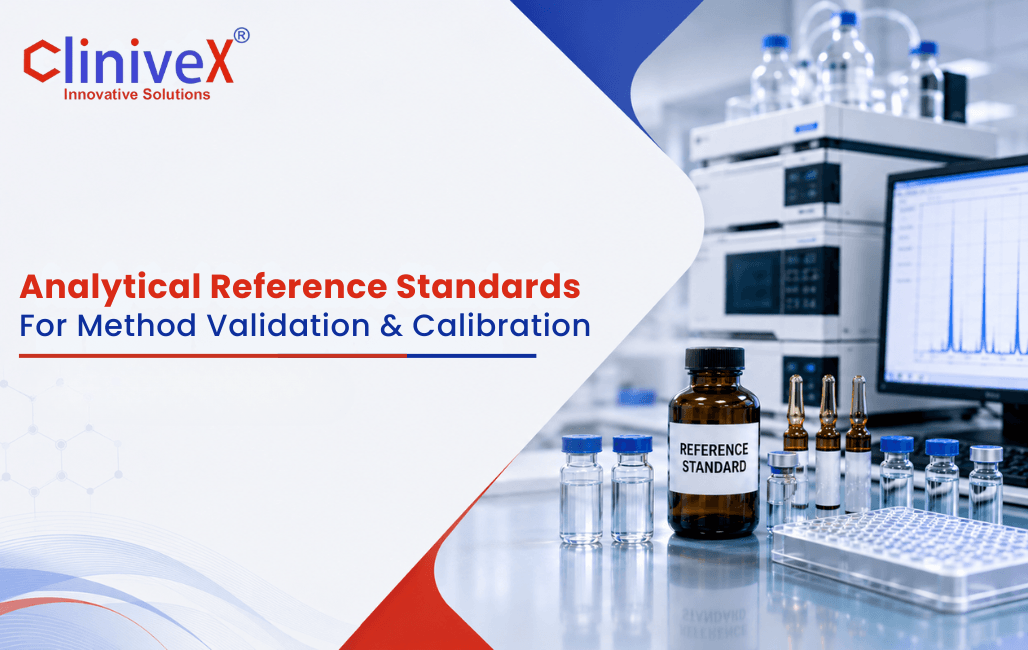

Whenever a laboratory routinely tests new samples, it must prove that its testing procedures are reliable and ideal for their intended purpose. This important process, combining instrument calibration with full method validation, ensures that every result is consistent and accurate. To build this foundation of trust, professionals must anchor their data to reliable benchmarks, or reference standards.
One of the most reliable benchmarks is an analytical reference standard. These are highly pure substances with a known and thoroughly verified chemical composition. They serve as the ultimate benchmark that is used to test, calibrate, and verify laboratory equipment. These standards are essential for supporting your methods and confirming that your laboratory results are truly accurate.
In this blog, we will explore how these key benchmarks support method validation and calibration.
Role of Analytical Standards in Calibration
Here’s how analytical standards support calibration:
The External Standard Method
This particular method relies mainly on preparing a separate series of known reference standards to build a calibration curve. It maps instrument response directly against the precise concentrations. This allows for a really smooth quantification of clean samples that lack complex background interferences.
The Internal Standard Method
By adding a constant amount of a distinct, pure substance to both your samples and standards, this method corrects for errors. It tracks how the standard behaves to correct for sample loss or instrument variations during the testing automatically.
The Standard Addition Method
This approach uses analytical standards to overcome harsh matrix effects by adding known concentrations directly to the unknown sample. Because both experience the same background conditions, it effectively bypasses complex interferences for accurate measurement.
Maximizing Instrument Sensitivity and Accuracy
Using highly pure standards provides labs with a reliable reference to establish the true instrument baseline. This helps in enhancing the instrument’s ability to detect trace concentrations. It reduces background noise and also improves the accuracy of every recorded measurement.
Analytical Standards & Method Validation
Using analytical standards is fundamental to validation for many reasons:
1. Accuracy & Precision
These materials provide the true chemical benchmark required to test your overall process. They allow you to verify how close your results are to the target value while ensuring the method produces consistent, repeatable data across multiple test runs.
2. Linearity & Range
Testing these benchmarks at multiple concentration levels proves that your system responds proportionally to different amounts. This data plots a reliable mathematical curve and establishes the lower and upper boundaries where your test remains accurate.
3. Method Specificity and Selectivity
The standards confirm your test can isolate and identify the target compound without error. Using a pure standard proves that background impurities, degradation products, or matrix components will not interfere with or distort your final measurements.
4. Stability and Consistency
They help evaluate how well your prepared chemical solutions resist breakdown over time. By tracking the standards’ performance under various storage conditions, you can establish safe expiration windows to ensure more consistent, long-term testing data.
Best Practices for Utilizing Analytical Standards Within Calibration & Validation
- Build multi-point calibration curves that cover the full concentration range.
- Prepare process standards using identical steps and matrix matching.
- Prioritize certified reference materials with the official CoA to maintain regulatory compliance.
- Store all standards strictly according to the manufacturer’s guidelines to prevent degradation.
- Use clean, calibrated glassware to eliminate manual dilution errors.
Why Supplier Quality Matters
Quality, traceability, and purity are non-negotiable for analytical reference standards, as they form the backbone of calibration and method validation. With this in mind, Clinivex provides certified analytical standards formulated to deliver exceptional accuracy, traceability, and reproducibility.
We ensure every product ships with a detailed Certificate of Analysis (CoA), including purity verification, uncertainty values, and full traceability.
Conclusion
Analytical standards are an important foundation for method validation and accurate instrument calibration. By partnering with a trusted analytical reference standards supplier in USA, your laboratory can gain the quality assurance required to navigate complex method validations and routine calibrations smoothly.
related blog
Analytical Reference Standards: The Key Benchmarks to Support Method Validation & Calibration
Whenever a laboratory routinely tests new samples, it must prove that its testing procedures are...

The Role of Reference Standards Suppliers in Meeting Reagent Purity Standards
Chemical reagents are the hidden backbone of scientific research, manufacturing, and quality testing. Whether it...

Stable Isotope Labelled Standards: Investing in High-Purity Material for Modern Scientific Research
Science and technology are moving incredibly faster than ever before. Today, the researchers are discovering...